
After a stellar 2023, the mutual fund industry sustained its growth momentum in 2024 with an impressive Rs 17 lakh crore surge in assets, driven by buoyant equity markets, robust economic growth, and increasing investor participation. Experts are predicting the positive trend will extend into 2025.

In the Union Budget for Financial Year 2023-24 (FY24), Finance Minister Nirmala Sitharaman had held forth on the need for better governance and investor protection in the banking sector. She had proposed certain amendments to the Reserve Bank of India Act (RBI Act), 1934; the Banking Regulation Act (BR Act), 1949; and the Banking Companies (Acquisition and Transfer of Undertakings) Act, 1970.

Raghuram Rajan called for purposeful and effective action to counter the atmosphere of cynicism, which has slowed down the decision making process.

'To the believers of crypto regulations, I have only one question to ask, how will you regulate it?'

The government seemed unhappy with Raghuram Rajan's interest rate policy.

RBI said more monetary transmission to support growth continues to be critical.

The recent agreement between the RBI and the Centre marks a significant step forward toward financial inclusion.
Priorities include the amendments of the Companies Act and the Motor Vehicle Act

Thanks to Rajan we are an inflation-targeting country now
.jpg)
Bank has cited trend of global easing and weak growth

In a major decision, the RBI on Friday announced that UPI payment limit to hospitals and educational institutions will be raised to Rs 5 lakh from Rs 1 lakh at present and hiked the cap for e-mandates for recurring payments to Rs 1 lakh. Unveiling the December bi-monthly monetary policy, Reserve Bank Governor Shaktikanta Das said the limit for various categories of Unified Payments Interface (UPI) transactions has been reviewed from time to time. "It is now proposed to enhance the UPI transaction limit for payment to hospitals and educational institutions from Rs 1 lakh to Rs 5 lakh per transaction," he said.

Taking on board India's concerns, the G-20 Summit on Friday acknowledged that excess volatility of financial flows and disorderly movements in exchange rates can affect economic and financial stability of emerging markets and called for sound policies to address it.

Policy rates have been reduced substantially in 2015.

The decision by the Reserve Bank of India to introduce a unified regulatory framework on connected lending for all the regulated entities (RE) is expected to reduce the influence of business conglomerates in the Indian lending space, said bankers and experts. "Connected lending pertains to lending to related parties within the same business group. "While the RBI might appear more agreeable to allowing business conglomerates to own banking licenses, it deems it crucial to bolster regulations that would prevent conglomerate-owned banks from gaming the system," said Shivaji Thapliyal, head of research and lead analyst, YES Securities.

'Even if there is a third wave or a fourth wave, it is hard to see the economy will suffer like that (during the first wave).'

In the current fiscal so far, retail inflation stabilised around 5 per cent, while wholesale price-based inflation averaged around 2.9 per cent during April-December.

The first major aspect is that of the veto power to the governor.

The Reserve Bank on Friday projected retail inflation to be in 5-5.2 per cent range during the first half of the next fiscal year, expecting further softening of vegetables prices in near term. Also, it has lowered the retail inflation forecast for the current January-March quarter of 2020-21 fiscal at 5.2 per cent. The Reserve Bank (RBI) has kept the key policy rate unchanged at 4 per cent, with an accommodative stance, so as to ensure that inflation remains well within the target, Governor Shaktikanta Das said while announcing the last monetary policy of 2020-21.

RBI is expected to discuss about the impact of GST in its monetary policy.
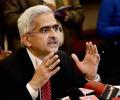
Reserve Bank Governor Shaktikanta Das on Monday said despite the latest headwinds arising from the Jackson Hole summit leading to extreme volatility, our banking system and financial markets are strong enough to withstand such pressures. Taking the markets by surprise, US Fed chair Jerome Powell had told the annual Jackson Hole summit of central bankers and economists last week that he would have to keep raising federal fund rates to tame inflation, which remains the biggest challenge to the world's largest economy. He also warned of the pains that such monetary policy actions would create on growth and jobs.

The cost of holding one-year forward dollars rose to 482.75 basis points from 472.75 bps on Tuesday.

Inflation in food articles during June stood at 2.04 per cent, as against 1.13 per cent in May.

The Reserve Bank on Thursday said it will come out with a framework allowing borrowers to switch to fixed interest rate from floating interest rate, a move that would provide relief to borrowers of home, auto and other loans reeling under the impact of high interest rate. Unveiling the bi-monthly monetary policy, Reserve Bank Governor Shaktikanta Das said under the framework, to be put in place shortly, the lenders will have to clearly communicate with the borrowers about tenor and EMI. "The supervisory reviews undertaken by the Reserve Bank and the feedback and references from members of public have revealed several instances of unreasonable elongation of tenor of floating rate loans by lenders without proper consent and communication to the borrowers," he said.

On the present government's 'Make in India' campaign, C Rangarajan, former chairman of the Prime Minister's Economic Advisory Council, says it is important to first ask for whom it is being made.

There is evidence of asymmetric adjustment to monetary policy

Observing that there is liquidity overhand of Rs 13 lakh crore in the system, RBI Governor Shaktikanta Das said on Friday that the exceptional measures undertaken during pandemic will be dealt in sync with macroeconomic developments to preserve financial stability. Since the onset of the pandemic, the Reserve Bank has maintained ample surplus liquidity to support a speedy and durable economic recovery, he said while announcing the outcome of the Monetary Policy Committee (MPC) meeting. The level of surplus liquidity in the banking system increased further during September 2021, with absorption under fixed rate reverse repo, variable rate reverse repo (VRRR) of 14 days and fine-tuning operations under the liquidity adjustment facility (LAF) averaging Rs 9 lakh crore per day as against Rs 7 lakh crore during June to August 2021, he said.

Subramanian, a senior fellow at the Peterson Institute for International Economics in Washington, attended a news conference in New Delhi at which his appointment was announced.

RBI could opt for a 'deep cut' after winning inflation war, say experts.

Inflation targeting framework is now enshrined as a formal agreement by the government and the RBI; thus, it may seem that we are flogging a dead horse, says Soumya Kanti Ghosh.

M V Subramanian says there is an imperative need for collective responsibility to tackle inflation, prices and availability of essential commodities, and not rely on inflation targeting alone.

There was no word on whether or when Patel would be talking to the media about his priorities and plan of action as head of Mint Street

A lot depends upon the composition of the monetary policy committee.

Three years after India declared its goal to become a net-zero economy by 2070, the policy design for achieving the target has begun, with the NITI Aayog forming dedicated multi-sectoral committees to prepare a transition plan. In 2021, India joined a select group of nations that set a target year for becoming net-zero carbon economy. At COP26 in Glasgow, Prime Minister Narendra Modi outlined a five-pronged 'Panchamitra' climate action target for India and committed to a net-zero target by 2070, joining nations like the US, the UK, and China.

A day after the Reserve Bank of India's monetary policy review, the RBI Governor talked to journalists on related issues.

For India, Fitch Ratings has 'BBB-' rating.
The Reserve Bank on Friday took steps towards normalisation of liquidity management to pre-pandemic levels, with the introduction of the standing deposit facility (SDF) as the basic tool to absorb excess liquidity, and narrowing the liquidity adjustment facility (LAF) to 0.50 per cent from the 0.90 per cent. Governor Shaktikanta Das said the SDF will be at 3.75 per cent, 0.25 per cent below the repo rate and 0.50 per cent lower than the marginal standing facility (MSF) which helps the banks with funds when required. The SDF has its origins in a 2018 amendment to the RBI Act and is an additional tool for absorbing liquidity without any collateral.

It's unfair to over-emphasise Urjit Patel's shy and reticent image.

A comprehensive technical framework needed, from which a more convincing policy could be demonstrated

Amendments to RBI Act likely soon

Rajan also said it's a problem of collective action and not a problem of industrial nations or emerging markets
 © 2026 Rediff.com - Advertise with us - Disclaimer - Privacy Policy - Sitemap - Feedback - About us - Terms of use - Grievances